I run a small clothing label, so I tend to think about charity merchandise from the fairly unglamorous end. Who is going to print it? Where will it sit? Who answers the email when someone needs a different size? And how much money will actually reach the cause?
I started Lonely Kids Club in Sydney in 2011. We print our tees to order and work with independent artists. Alongside our fundraising ranges, we’ve supported 50-plus requests this year through vouchers, free clothing, free printing and donations. The help people need varies quite a bit, which is a good place to start when you’re approaching a business.
Be specific about what would be useful. A raffle might need a voucher. An event might need shirts for volunteers. A fundraising range needs someone to manage sales and get orders out. Each involves different costs and work, so have that conversation before getting too far into the design.
Work out who carries the stock
A low unit price per shirt can look appealing on paper until you are left with boxes of unsold sizes nobody ordered. For a not-for-profit operating on a tight budget, cash tied up in dead stock is money that cannot be used for frontline work.
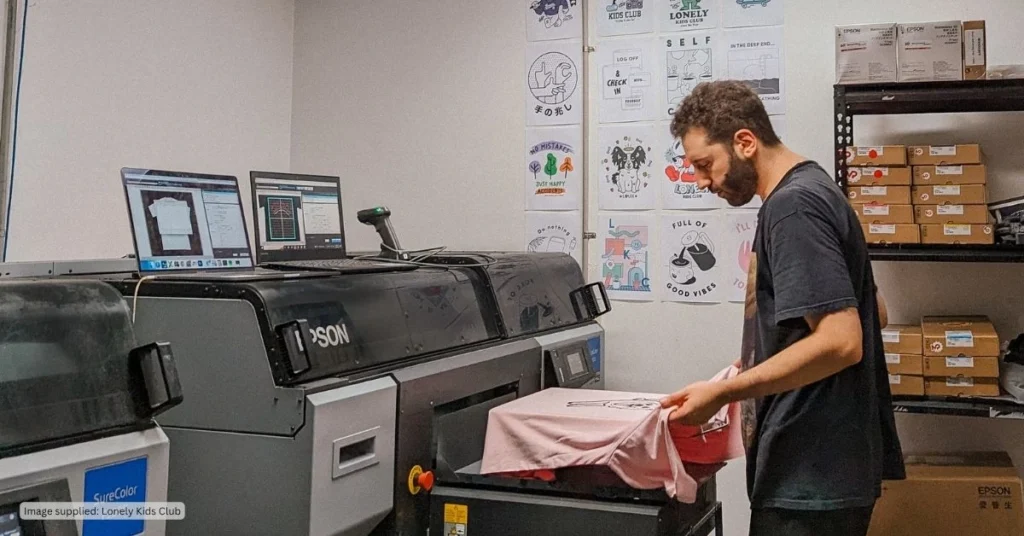
At our label, we print designs only after an order is placed, using blank garments held for production. This removes the guesswork around how many finished units a particular design will sell. However, while printing to order eliminates inventory risk, someone still pays for blanks, inks, and production time. There is always a tangible cost to making each shirt.
If you are considering a bulk order, establish early who pays for unsold inventory and what happens to it afterwards. If you are taking pre-orders or printing to order, be realistic about production and delivery lead times. Shirts for an event must arrive well before event day, and a printer’s stated turnaround time rarely accounts for postal delays.
Leave room for the actual work
In the lead-up to our 2023 Game On Cancer range, our Black Friday workload pushed back the first design concepts. We had ideas ready to develop, but the same small team was also dealing with customer orders.
It’s worth asking a prospective partner what else is on their calendar. Allow time for artwork, feedback, samples and photographs before promising a launch date. Ask who will approve things and who will be available if something needs changing. A quick answer to a design question can make a real difference when you’re trying to get a project moving.
The charity’s input matters well before launch, too. Our artist Claire Harrison worked with the Game On Cancer team on designs connecting gaming and cancer research. There was back and forth over the artwork, including making lettering work against different shirt colours and checking the wording about cancer research.
An NFP brings knowledge of its cause and community that a clothing business won’t necessarily have. Give the people making the merchandise that guidance early. Share any wording that needs care, and look at whether the design feels like something your supporters would actually wear.
Be clear about the donation
Our Science Meets Gaming tee commits 100 per cent of its profits to Game On Cancer, an initiative of Cure Cancer. With a profit-based donation, the costs need to be understood. The sale price still has to cover making the item.
Before agreeing to a range, work through a sale with the business. What is deducted? How are discounts and returns handled? When will the charity receive the money, and what record of sales will come with it? Put the agreed approach in writing so both sides can explain it consistently.
A set dollar amount per item can be easier to explain, provided the costs allow for it. Whatever you agree on, put the donation details where someone can see them before buying. Name the recipient and make clear which products are included. If a campaign has an end date, show that as well.
Afterwards, check what the project actually raised and how much work it took. Keep donated clothing, printing and vouchers separate from cash raised when reporting the result. They can all be useful, but they tell you different things about the support provided.
There’s a lot of goodwill behind these projects. Sorting out the practical details gives everyone a better chance of following through. Start with something your team and your partner can manage, then see whether it makes sense to do it again.
Read also: Unearthing a wellspring for workforce sustainability

Warwick Levy
Warwick Levy foundedLonely Kids Clubin Sydney in 2011. The independent clothing label prints its graphic tees to order and works with artists from Australia and overseas. Alongside running the business, Warwick works on merchandise collaborations and fundraising projects supporting charities and community groups.


 Trending
 Popular