
Every for-purpose leader knows the feeling of being asked to do more with less. More services, more reach, more evidence of impact, and a technology landscape that is moving faster than most boards and leadership teams can comfortably track. AI has sharpened that tension. The possibilities are enormous, but so are the questions about data, governance and who has the capability to act on any of it.
What is less often discussed is the role of the people who sit beside organisations in that work: the implementers, consultants and technologists who are neither on the frontline nor in the spotlight. Their best work depends on trust, patience and a willingness to learn the culture before trying to change it. This conversation is about that relationship, and about what the commercial and for-purpose worlds can each learn from the other.
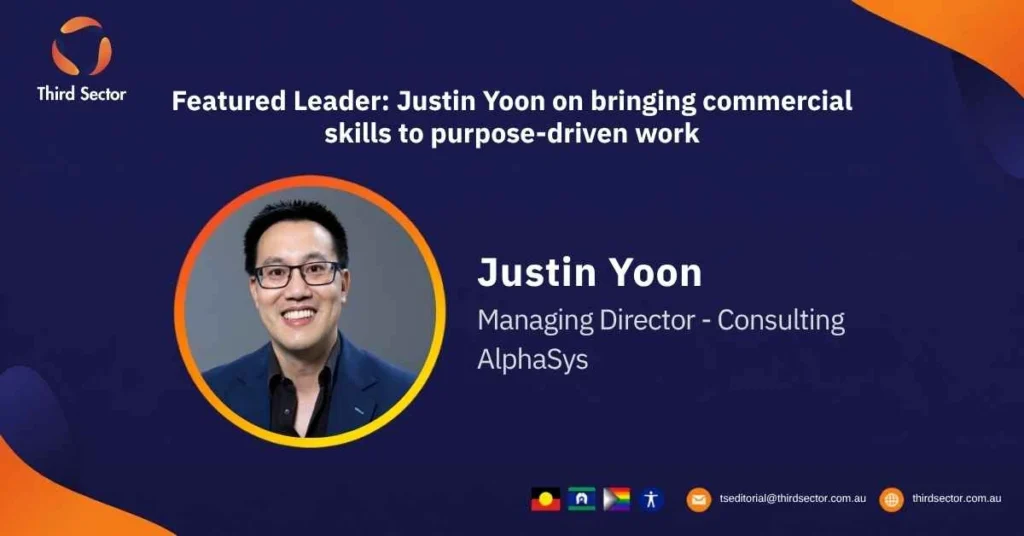
Justin Yoon is Managing Director – Consulting at AlphaSys. He began his career in consulting and audit with high-profile financial services organisations before moving into Salesforce, where he found the point at which, in his words, his career and his sense of purpose came together.
Q&A with Justin
What inspired you to pursue a career in the social sector?
I started my career in consulting and audit, working with some high-profile organisations in financial services. I enjoyed the work and learned a huge amount, but I became increasingly aware that the end result was often more commercial value for an organisation.
I knew there were organisations doing work that had a much more direct impact on people’s lives, but they didn’t always have access to the same skills, resources or technology available in the commercial sector. I started thinking about how those capabilities could be put to work in a different context.
When I moved into Salesforce, I had the opportunity to do exactly that. We could bring together strong commercial thinking, technology and the expertise of our team, and apply it to organisations whose purpose was to make a difference. That was the point where my career and my sense of purpose really came together.
What is the most fulfilling part of your work?
The most fulfilling part is seeing the impact of what we do through the success of the organisations we work with. When a client recognises where they have gaps and genuinely wants to work with us to address them, it creates a very different kind of relationship. We become invested in the outcome together.
That’s particularly rewarding in the for-purpose sector because the end result isn’t just a successful project or a better system. It’s an organisation being able to raise more money, deliver better services, or reach more people.
We often describe ourselves as the superhero’s sidekick. The organisation is the one on the frontline doing the work and getting the recognition, while we’re behind the scenes helping them succeed. There’s something very satisfying about knowing you’ve played a part in making that possible, even if you’re not the one in the spotlight.
What is the most impactful project you have worked on so far?
It’s difficult to choose one because impact looks very different across the for-purpose sector. We work with organisations raising funds, delivering services, supporting education, and helping people in very different circumstances. What stands out to me as impactful are the relationships where the client genuinely sees us as part of their team. Our first client, Mission Aviation Fellowship, is still a reference client 12 years later. We’ve worked through three CEOs with them, helped them evolve their fundraising and service delivery, and over time the relationship became a genuine friendship. We’d have Christmas lunches together, our families knew each other, and there was a shared sense that we were all working towards something greater. Relationships Australia South Australia is another example. We challenge each other, we have the tough conversations when we need to, but there’s a genuine sense that we’re working as one team to make the organisation better at serving the community. That’s the kind of partnership I find most fulfilling: when you’re invested in the outcome together, and the relationship continues to grow alongside the organisation.
What are the biggest developments you have seen in the social sector so far?
The biggest shift has been the move from thinking about individual functions to thinking about the organisation as a connected system.
When we started, Salesforce’s role in the sector was heavily focused on fundraising. Today, organisations are connecting fundraising with service delivery, advocacy, volunteering and the outcomes they’re creating for the people they serve.
I think of it as a flywheel. The support an organisation receives enables it to deliver services. The outcomes from those services create stories and evidence that help attract more funding, volunteers, and advocacy, which in turn enables the organisation to support more people.
We’re also seeing organisations think much more seriously about personalisation. Someone might be a donor, volunteer, advocate, and beneficiary of the same organisation. They don’t see themselves as four different people, so organisations need to understand the whole relationship. AI is now accelerating that shift. It’s creating enormous possibilities, while also putting much more attention on the data, governance, and security foundations underneath it.
Read also: “Professional distance is never an appropriate basis for raising children”
What do you think is the biggest challenge facing our sector nowadays?
One of the biggest challenges is having the talent and capability to keep pace with technology.
AI is moving incredibly fast, and for-purpose organisations are competing for expertise in a market where they often can’t match the budgets of larger commercial organisations. At the same time, boards and leadership teams need to understand enough about the technology to make good decisions about where to invest. So there’s a real tension between the desire to move quickly and the need to do it responsibly.
I think the answer is to build capability deliberately. Get the foundations right, start with practical use cases, learn from them, and keep building. We’ve taken that approach with our own team and with our clients. AI isn’t something you implement once and move on from. It’s a continuous process of learning and improvement.
What emerging technology or trends do you believe will shape the sector’s future?
AI will have a major impact, but I’m particularly interested in how it changes the ability of organisations to manage their own technology stacks.
For the social sector, that could be extremely powerful because it gives organisations greater control over how they solve their own problems. That changes our role as well. We want to give clients the foundations, tools, and governance they need to build capability themselves, while being there when they need deeper expertise.
That’s why I keep coming back to foundations. If your data, systems, and governance are right, you create an environment where new technology can be adopted much more effectively.
I also think there is a huge opportunity for organisations to learn from each other. We’re looking at ways to bring clients together around AI so they can share what they’re learning rather than every organisation having to solve the same problems independently.
What advice would you give aspiring leaders in this sector?
Take the time to understand the environment before trying to change it.
Coming from the commercial world, it’s easy to assume that the same approaches will work in a for-purpose organisation. However, the dynamics are different. An organisation might answer to government funders, donors, a board, its community and the people it serves, all with different expectations.
Even something as simple as efficiency can mean something different. In a commercial organisation, efficiency might be about reducing costs. In a for-purpose organisation, it can mean freeing people up to spend more time delivering services or creating better outcomes.
So I would encourage anyone moving into the sector to listen first. Learn the team, understand what motivates them, and take the time to understand the culture before making major changes.
Recognise that the learning goes both ways. There is a lot the for-purpose sector can learn from the commercial world, but there is just as much the commercial world can learn from the for-purpose sector.
Tell us more about your organisation. What is something unique about it?
AlphaSys is a technology implementation and consulting partner focused entirely on the for-purpose sector. We’ve been doing this for more than a decade, so we’ve built a deep understanding of how these organisations work and the challenges they face. We’ve seen other organisations broaden their focus over time, but we’ve deliberately stayed in this sector.
Our role is to bridge two worlds: understanding the complexity of for-purpose organisations while also understanding what technology can make possible.
That same sense of purpose extends to how we built the business itself. We’re intentional about creating opportunities for people, investing in their development, and building an environment where expertise is valued regardless of where someone is based. We want the way we operate as a business to reflect the values we bring to our client work.For me, that’s fundamental to AlphaSys. We’re a commercial organisation, but purpose influences how we work, who we work with and how we build the business.
Share Your Story
Third Sector regularly features the perspectives of leaders working across Australia’s not-for-profit and social sectors. If you are wrestling with questions like these in your own organisation, or you have built something that challenges how the sector usually does things, we would like to hear about it. Get in touch to share your story with our readers here.

Ritchelle is Content Team Manager at Akolade, producing stories for Australia's not-for-profit sector at Third Sector.



 Trending
 Popular