

Ask almost anyone working in child and family services what changes a young person’s life, and the answer comes back the same: relationships. It is in the research, the practice frameworks, the strategic plans and funding submissions. And yet the systems built around that conviction are organised for something else entirely: short contracts, rostered shifts, rotating staff and forms designed to demonstrate that something was done rather than that anyone stayed.
That gap between what the sector says it values and what children and families experience is the subject of this conversation. It runs through questions of professional boundaries, institutional risk, measurement, First Nations self-determination and what leadership asks of us. It also lands somewhere uncomfortable for most organisations: many of the changes that would close the gap do not require new money or new legislation. They require a willingness to look honestly at the habits we have built for our own protection.
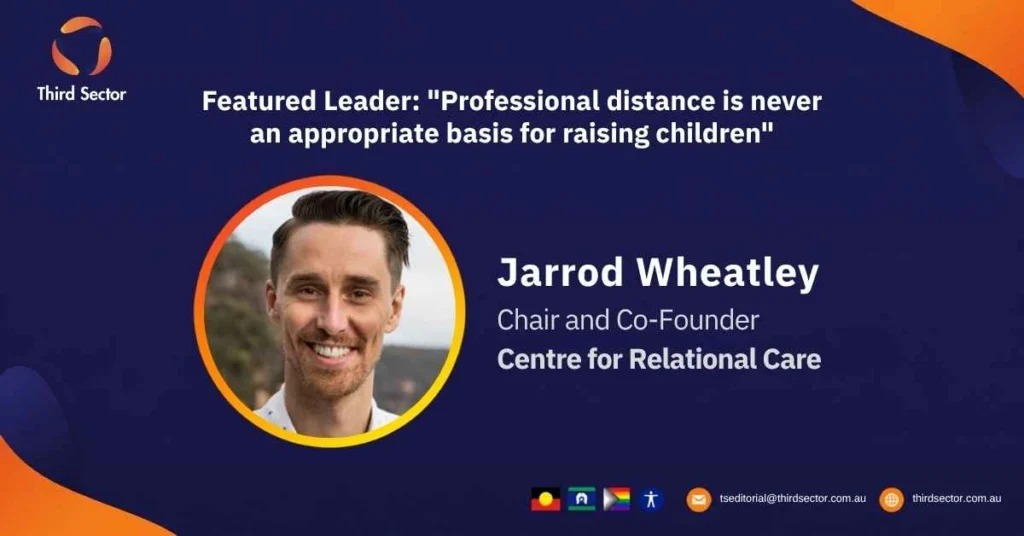
Jarrod Wheatley is Chair and Co-Founder of the Centre for Relational Care (CRC) and Founder and Chief Executive Officer of Professional Individualised Care (PIC), a pioneering model of out-of-home care with an emphasis on trust, consistency and healing relationships for children and young people.
Since 2005, he has worked across the youth and community sectors, from coordinating a youth service in New South Wales to developing and implementing programs for refugees in Germany. At the CRC, he leads efforts to influence policy, legislation and regulation in NSW’s child protection and out-of-home care systems to centre relational approaches. He was named NSW Youth Worker of the Year (2014) and NSW Young Australian of the Year (2019), and received the Medal of the Order of Australia (OAM) in 2022 for service to youth.
Q&A with Jarrod
What experiences have most shaped the way you think about working with children and young people?
Straight out of high school, I ran the Katoomba Youth Centre in the Blue Mountains with a small team. I was fortunate to have that as my first experience of the sector. Young people had ideas, and we set about making them happen. It was a great incubator for learning how to build programs around what young people were asking for. I had a supportive environment, stable funding and young people full of ideas. What could go wrong!
Looking back, though, I was still influenced by the broader culture of the sector. I said no to attending a birthday party for a young person with disability and to going to young people’s footy training on my days off. I was told those were the rules, and I followed them even though they felt wrong.
It was not until I worked overseas with refugees, across many cultural contexts, that I began to see that the widespread adoption of clinical ideas about professional distance was not the only way to reach out and help people.
Children who have experienced extraordinary instability rarely need another professional passing through their lives. They need people who know them, stay with them and care about what happens next.
What are some of the biggest changes you’ve seen in the social sector over your career?
There have been important changes over the past two decades. We understand much more about trauma, attachment, family preservation and lived experience. There is greater recognition that services should be designed with people rather than for them. There is also broad support for the growth of Aboriginal-led organisations. Thanks to years of impressive advocacy, NSW law now requires Active Efforts to keep Aboriginal children with family, return them home or connect them with kin, community and culture.
But some changes have occurred more in language than in practice. For example, we talk about relationships while designing services around short funding cycles, rotating staff and professional distance. We talk about being trauma-informed while repeatedly requiring people to retell traumatic experiences to changing professionals, or raising children in out-of-home care through shift-work-based models.
We need to look at what children and families experience. Do they have more say? More stability? Are there people in their lives who know them and stick around?
What do you think are the biggest challenges facing the child and family sector today?
I do not think the main problem is a lack of research or committed people. We are fortunate to have people with lived experience and First Nations advocates telling the system clearly what is helpful and what is damaging. We already know that relationships are central to healing and change. We know that self-determination and community-led action produce better results.
The deeper problem is that our systems are organised around managing institutional risk, demonstrating compliance and protecting organisations and governments from blame.
Real relationships involve uncertainty, emotional exposure and contextual judgement. Our understandable discomfort with these things leads us to create more procedures, assessments, approvals and boundaries, even when they don’t produce greater safety or better results. Each may appear reasonable on its own, but together they can crowd out the relationships the system claims to value.
This is not a criticism of one part of the sector. My experience is that people across government, services, communities and the frontline recognise these drivers and want to change them. None of us has the complete answer. The work is about finding others who see the problem, supporting change that’s already being led by community organisations, and helping people see that an alternative is possible.
What does good relational practice look like to you?
Warm communication, careful listening and good rapport are all important, but they are not necessarily the same as a genuine relationship.
A genuine relationship involves recognition, continuity and mutuality. This does not mean both people have identical responsibilities or power. It means the person is not treated primarily as a client, case or collection of risks. They can influence the relationship, while the practitioner brings appropriate humanity to it and is willing to be known and affected.
Relational practice is therefore not simply a friendlier way of delivering the same system. It asks institutions to reconsider power, continuity, boundaries and professional distance.
Building rapport without sharing much of oneself may be entirely appropriate depending on the role. But I would argue that professional distance is never an appropriate basis for raising children.
You’ve spoken about the idea of a Child Connection System. What would that look like in practice?
No statutory system can fulfil the broad promise that government and organisations can protect every child from abuse and neglect. Most children’s lives take place beyond its sight, and safety is primarily created through families, relationships and communities.
A Child Connection System would begin with a different question: does every child have enough safe, attuned and enduring adults around them?
It would offer practical help before crisis becomes an investigation, strengthen extended family and community networks, and prioritise relationships that can endure beyond a placement, contract or eighteenth birthday. For First Nations children, it must also mean community authority and self-determination rather than government retaining control while inviting participation.
This is not a completed blueprint, nor an argument against statutory intervention where it is needed. It is a different organising purpose: government creating the conditions for connection rather than imagining that professional services can replace the protective role of families and communities.
How should we be thinking about success and accountability in child and family services?
What we measure tells people what the system really values. If we primarily count assessments, contacts, case-plan reviews and completed records, people will understandably organise their work around producing them.
We should also ask: does this child have someone who knows them deeply? Who would they call at night? Is the same person still in their life a year later? Has their network of safe relationships grown or become smaller? Do children and families experience services as helpful and trustworthy?
It’s also about being accountable to the people whose lives are affected, not only upwards through organisations and government. Services should be accountable for what they can influence: whether people feel helped, what the service has learned and what it has changed. That is more honest than asking a service to claim outcomes over which it may only have a small influence.
Quantitative measures remain useful, but we should not confuse what is easiest to count with what matters most. We need to commission for learning and build relational accountability into the way services are governed.
Read also: Inside Equal Threads: SSR’s bold bet on a second funding engine
What have you learned about leadership over the course of your career?
I think the more complex your work is, the more you need to work with and trust others.
My base assumption when I look at an issue now is that the person closest to the problem knows more than I do about it, and that most people, when given opportunity, support and challenge, are motivated to do good work. Leadership requires accepting your limitations, a lot of observing, and using the influence you have to help make progress.
Progress at scale in complex systems can only be achieved by helping others do good work, rather than by the sheer willpower of one person. That said, it helps to be likeable when you can, to try to only disappoint people sustainably, and not let the heat get too hot or cold. It goes a long way when you work with a clear sense of purpose.
Leadership is a role, not all of who someone is. When in doubt, I try to be myself and remind others that I have a role to play, while still trying to be genuine and not get too caught up in the role. I don’t find leadership particularly comfortable, but when I am fortunate to have some influence (as I do within my organisation), it is a privilege to try and be useful and serve the system I work in.
Lastly, I would say that most people are blind to their own power in a system but can see the power of others. This seems to be the case whether you are two years into your work or the minister. I try and remind myself I have some power whether I feel it or want it or not; it’s good to use it to try and help others to own their power. It all sounds pretty easy when I write it like that, but of course it is the living of these ideals that’s tricky.
Tell us about the work of Professional Individualised Care and the Centre for Relational Care. What have those organisations taught you about putting these ideas into practice?
Professional Individualised Care was informed by a German model of out-of-home care and built around the idea that children who have experienced significant trauma should live in stable homes with adults who have the capacity and commitment to form genuine relationships with them.
Rather than relying on rotating workers, the model gives professional carers the time, support and organisational backing to make the relationship central. The child is not treated as a unit moving through a program. The home and the relationship provide the conditions that can help children move out of constant hypervigilance and begin to make sense of their past.
This work has taught us that relationships cannot simply be added to a practice framework. PIC has also taught me that no model can make relationships easy. Relationships do not spare us discomfort or disappointment; they often create both. But by supporting them, we are working with the thing that most often changes people’s lives.
The Centre for Relational Care grew from recognising that individual programs can only go so far when policy, regulation and organisational culture pull in the opposite direction. Its work has also shown me that I am not alone: there is a growing movement in Australia and overseas calling for future services to be built around relational practice.
Where do you think we could start making changes now?
There are meaningful changes that services can make without waiting for new government policy, legislation or commissioning arrangements.
First, have an honest workforce conversation about boundaries. Ask why a one-size-fits-all model based on clinical professional distance is being applied in non-clinical settings. What kinds of boundaries actually support safety and genuine relationships in this work? Then translate that discussion into new organisational norms, supervision and policy.
Second, conduct a ‘paperwork purpose’ audit. Select a meaningful portion of your forms, reports and approval processes and ask: does this improve care or outcomes, or does it mainly protect the organisation? Remove what you control. Where an external requirement prevents removal, use the findings as a specific advocacy tool.
Third, leaders can establish connection as an explicit organisational purpose. That purpose should then shape decisions, policies and measurement. Leaders can begin asking whether their organisation is increasing the number and strength of enduring relationships in people’s lives.
Government could also make three practical changes now.
First, change the questions asked of services. Do not ask only whether required activities occurred. Ask whether the child is more connected, whether important relationships have endured and whether their network of safe adults has grown.
Second, begin a process to repeal and replace current child protection legislation so that it enables a differential response, including a genuinely voluntary pathway for families who need help rather than investigation.
Third, begin developing a new social contract for the sector, led by people affected by the system and those working across it. This should define a shared purpose and a more realistic role for government — one it can actually fulfil — alongside the responsibilities and authority of families and communities.
None of these changes requires major new service expenditure to begin. They are principally about aligning our systems with the values most people across the sector already share.
Share Your Story
Third Sector regularly features the perspectives of leaders working across Australia’s not-for-profit and social sectors. If you are wrestling with questions like these in your own organisation, or you have built something that challenges how the sector usually does things, we would like to hear about it. Get in touch to share your story with our readers here.

Ritchelle is Content Team Manager at Akolade, producing stories for Australia's not-for-profit sector at Third Sector.

 Trending
 Popular