We talk a great deal about the moment a woman leaves violence. We talk far less about the day after. The lease she can’t get without a rental history, the debts accumulated in her name, the children who need a school and a routine, and the crisis bed that can’t be freed up because there is nowhere affordable to move on to. For many families, the dangerous part of the journey is not only leaving but, more importantly, the gap between refuge and a home of their own.
That gap sits at the centre of this conversation, and it connects housing, family violence, health, legal and community services in a way the system rarely does. It is also a question of dignity, of who gets to shape the services designed for them, and of what cultural safety looks like when it is practised rather than promised. These are the same questions at the heart of the 4th National Family Safety Summit in Darwin this November, where continuity of care and coordinated action are central themes.
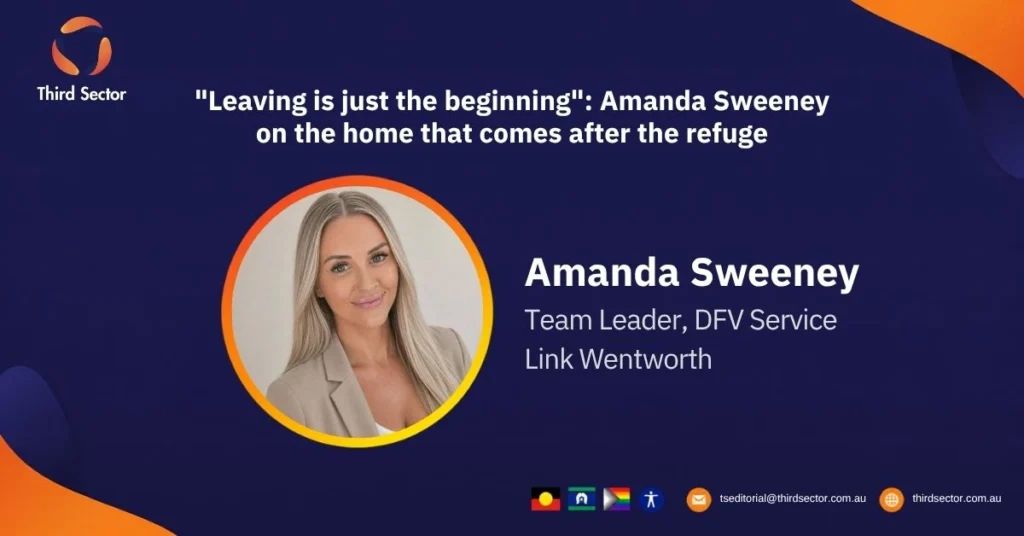
Amanda Sweeney is the Domestic and Family Violence Team Leader at Link Wentworth. Her work focuses on the connection between safe housing, independence and recovery for victim-survivors, including the role of culturally safe services and lived experience in shaping better support.
Q&A with Amanda
Beyond physical safety, how does having a stable home help women and children regain their independence and rebuild their lives?
A safe and stable home is about so much more than having a roof over your head. It provides the foundation for healing, independence, and the opportunity to start rebuilding a life that may have been controlled by someone else for a long time.
For women, having a home of their own can mean regaining control over their decisions, reconnecting with family and friends, returning to work or study, and beginning to make choices for themselves and their children without fear. For children, stability provides the opportunity to return to school, build friendships, establish routines, and experience the consistency and security every child deserves.
We often talk about the importance of leaving violence, but we also need to talk about what happens afterwards. Leaving is just the beginning. Without somewhere safe and affordable to live, women can find themselves trapped between the violence they have left and the uncertainty of homelessness. A stable home gives women and children the space, time and security to heal, rebuild their confidence and begin to imagine a future beyond survival.
What is the biggest hurdle stopping families from moving out of crisis accommodation and into permanent housing?
The biggest barrier is the lack of safe, affordable, and appropriate long-term housing. We can provide excellent case management, practical support, and pathways towards independence, but if there is nowhere affordable for a family to go, their options remain extremely limited.
Women leaving domestic and family violence are often trying to rebuild their lives while managing financial abuse, disrupted employment, rental affordability challenges and the costs associated with establishing a new home. Some have had their finances controlled or debts accumulated in their name by a perpetrator. Others may face rental discrimination or struggle to secure a property without a strong rental history.
For families with several children, accessibility needs, pets or complex safety concerns, the options can be even more limited.
Crisis accommodation is designed to provide immediate safety, but it cannot become a long-term solution simply because the next step is unavailable. When families cannot move on, it affects their recovery and limits the availability of crisis accommodation for other women and children who urgently need it.
We need to recognise that this is not a failure of the woman or the support service. It is a structural housing issue that requires a stronger supply of social and affordable housing, better access to private rentals and more flexible pathways into permanent accommodation.
How does the Core and Cluster model give families more privacy and dignity compared to traditional refuges?
The Core and Cluster model offers an important shift towards providing safety while preserving privacy, autonomy, and dignity. Rather than families sharing communal living spaces, the model provides self-contained accommodation, with private living areas and facilities, alongside access to support services.
That difference can be significant for women and children who have experienced control, surveillance, and a loss of independence within a violent relationship. Having their own space allows families to establish routines, prepare meals, spend time together and make everyday decisions in a home environment that feels more like their own.
For children, having space and privacy can help restore a sense of normality at a time when so much of their lives may have been disrupted. For women, it creates opportunities to practise independent living while still having access to specialist domestic and family violence support, safety planning, and practical assistance.
The model also recognises that recovery is not one-size-fits-all. Families need different levels of support at different stages of their journey, and their accommodation should reflect that.
Ultimately, Core and Cluster is about more than the physical design of a building. It is about creating an environment where women and children can feel safe, retain their dignity and begin rebuilding their lives without losing their independence in the process.
How can housing services build genuine cultural safety and support healing for Aboriginal families?
Cultural safety needs to be embedded in the way services operate, not treated as a training session or a statement on a website. For Aboriginal families, this means being welcomed, listened to, and supported without having to navigate assumptions, stereotypes or systems that do not understand their experiences.
Services need to recognise the ongoing impacts of colonisation, intergenerational trauma, and systemic discrimination, while also recognising the strength, resilience, culture, and connection that Aboriginal families bring.
Genuine cultural safety means listening without judgement, building trust over time, respecting family and community connections, and understanding the importance of connection to Country, culture, and kinship. It also means recognising that every Aboriginal family is different and that support must be guided by the individual family’s needs, wishes, and circumstances.
Aboriginal-led organisations, Aboriginal workers, and community-controlled services are essential partners in this work. Services need to invest in these relationships, share decision making, and ensure Aboriginal voices influence how support is designed and delivered.
As an Aboriginal woman working in the DFV sector, I believe cultural safety is demonstrated through our actions. It is reflected in whether a woman feels safe enough to ask for help, whether she is believed when she shares her experiences, and whether she can access support without feeling she has to leave her culture or identity at the door.
Housing should be a place where Aboriginal women and children can feel safe, connected and supported to heal, while maintaining their cultural identity and connections to community.
How can organisations genuinely involve victim-survivors in designing services without it feeling like a tick-box exercise?
It starts with recognising that victim-survivors are experts in their own experiences. They understand the barriers they have encountered, what has helped them and what could have been done differently. Their knowledge needs to be valued alongside professional and service-system expertise.
Genuine involvement means creating opportunities for women to contribute in ways that feel safe, accessible, and meaningful. This may include voluntary feedback, paid consultation, advisory groups, co-design workshops, or ongoing opportunities to shape policies and service delivery. Participation must never be a condition of receiving support, and women should never feel pressured to revisit traumatic experiences to help an organisation improve.
Organisations also need to close the feedback loop. If women share their experiences and recommendations, they should be told what has changed as a result, what cannot change and why. Otherwise, consultation risks becoming an exercise in collecting stories without creating meaningful outcomes.
We also need to hear from women whose voices are often underrepresented, including Aboriginal women, women from culturally and linguistically diverse communities, women with disability, LGBTQIA+ victim-survivors and women living in regional areas.
Most importantly, co-design requires a willingness to share power. It means being prepared to challenge established practices, acknowledge where systems have fallen short and make changes based on what victim-survivors tell us.
The measure of genuine participation is not how many consultation sessions we hold. It is whether women can see their experiences reflected in better services, safer housing options and improved outcomes for themselves and their children.
What changes are needed to help more women and children access safe, long-term housing?
We need to move beyond treating domestic and family violence and housing insecurity as separate issues. They are deeply connected, and our responses need to reflect that.
First, we need a significant increase in safe, secure, social, and affordable housing, alongside more accessible pathways into the private rental market. Women should not have to compete for a limited number of properties while trying to recover from violence and rebuild their financial security.
Second, we need stronger pathways from crisis accommodation into permanent housing. This includes flexible financial assistance, help with rental bonds and establishment costs, tenancy support, and ongoing case management where needed. Housing options must also account for children’s needs, disability, cultural connections, pets, and the safety risks associated with leaving a perpetrator.
Third, we need better integration between housing, DFV, health, legal and community services, so women are not left navigating multiple systems on their own. Specialist DFV services need sustainable funding, adequate staffing, and the flexibility to respond to the complexity of each family’s circumstances.
We also need to recognise that safety does not end when a woman leaves a refuge or signs a lease. Ongoing support can be critical to maintaining a tenancy, rebuilding financial independence, and reducing the risk of returning to an unsafe situation because there are no viable alternatives.
Ultimately, women and children should not have to choose between safety and a home. We need a housing system that understands the realities of domestic and family violence and responds with practical, long-term solutions. A safe home should not be a privilege reserved for those who can afford it or navigate a complicated system. It should be a foundation from which every woman and child can recover, thrive and build a future on their own terms.
Amanda Sweeney will share insights into safe housing, recovery and victim-survivor-centred support at the Family Safety Summit. The event brings together practitioners, leaders and advocates to explore practical approaches to preventing family, domestic and sexual violence and improving support for victim-survivors.

Ritchelle is Content Team Manager at Akolade, producing stories for Australia's not-for-profit sector at Third Sector.


 Trending
 Popular