
Financial hardship can arrive suddenly, even for people who have managed their money successfully for years. A job loss, illness or unexpected setback can quickly create problems that are difficult to navigate alone.
For social sector organisations, the challenge is helping people before those problems become a deeper crisis. That means making support easier to access, connecting services more effectively and recognising that recovery can involve rebuilding confidence and skills as well as addressing immediate financial needs.
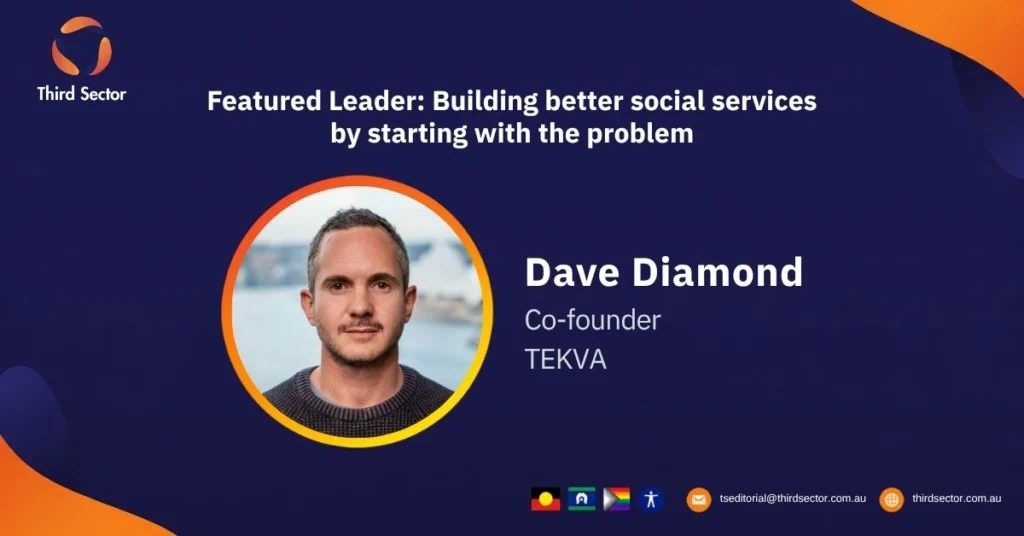
For Dave Diamond, co-founder of TEKVA, this is where technology and social support can work together. His approach focuses on intervening early, understanding what is putting someone at risk and reducing the barriers that make getting help harder.
Dave Diamond co-founded TEKVA after working in business, technology and artificial intelligence. Seeing people experience job displacement and sudden financial hardship prompted him to apply his experience in product development and problem-solving to the social sector.
Q&A with Dave
What inspired you to pursue a career in the social sector?
I didn’t really plan to. I came from building businesses and working with technology and AI. As AI accelerated, I started seeing people around me being displaced from jobs, struggling to get back into work, and suddenly facing financial problems they had never experienced before. What struck me was how quickly someone could go from doing fine to being in genuine financial trouble, and how difficult the support system could be to navigate once they got there.
That was really the starting point for TEKVA. I thought some of what I’d learned about building products, removing friction and solving problems quickly could be useful in helping people through that period before a setback becomes a much bigger crisis.
What is the most fulfilling part of your work?
Seeing something actually change for someone. Not just giving them information or referring them somewhere, but helping turn a pretty overwhelming situation into a series of things that can actually be dealt with.
What is the most impactful project you have worked on so far?
Building TEKVA. We’re still early, so I’m careful not to overstate our impact. We started with a simple question: what happens to someone who has always managed financially, then suddenly loses a job, gets sick or has something else go badly wrong? We’ve been building and testing a model around that gap: intervene early, work out what is actually putting someone at risk, bring together financial counselling, practical support and capability, and use technology to remove as much friction as possible. The most interesting part has been building while delivering the service.
Every real situation teaches us where the system works, where people get stuck, and what we should build or change next. Where those tools or learnings can help beyond TEKVA, we want to share them with the sector.
What are the biggest developments you have seen in the social sector so far?
The cost of building has collapsed. Small organisations can now create tools, automate administrative work, analyse information and test ideas that previously required serious technology budgets. At the same time, the technology enabling that is changing the problems the sector will have to respond to. We’re already seeing people displaced from work, struggling to find comparable roles and facing financial hardship after long, stable careers. I think the social sector needs to understand both sides of that shift.
Read also: “The superhero’s sidekick”: Justin Yoon on bringing commercial skills to purpose-driven work
What do you think is the biggest challenge facing our sector nowadays?
Fragmentation. There are extraordinary organisations and people doing good work, but someone in crisis still has to navigate multiple services, eligibility rules, referrals and hand-offs. Too much of the burden of coordinating the system still sits with the person who is least equipped to carry it at that moment.
What emerging technology or trends do you believe will shape the sector’s future?
AI, without question. It will change how social-sector organisations operate, but it will also change who needs our help and why.
Used responsibly, AI can reduce repetitive frontline administration, help people navigate complex systems, improve triage and give small organisations capabilities previously reserved for much larger ones.But we also need to prepare for the other side of it. Employment disruption can become financial hardship very quickly. For organisations like TEKVA, understanding that transition and intervening early is going to become increasingly important.
What advice would you give aspiring leaders in this sector?
Get close to the actual problem before designing the solution. Talk to the people experiencing it and the frontline workers dealing with it every day. Then build the smallest useful thing you can, see what happens, and change it quickly.
Tell us more about your organisation. What is something unique about it?
TEKVA is a small Australian charity focused on helping people who have hit sudden financial hardship before the situation becomes much harder to recover from.
One thing that makes us a little different is that we combine direct support with capability building. That can mean financial counselling and practical relief, but also helping someone rebuild their confidence and skills after losing work. We’ve been experimenting with one-to-one AI upskilling, where people learn how to use AI practically for job searching, CVs, research, learning and solving everyday problems themselves.
We also use what we learn from delivering the service to build better tools and processes, and where something we create could be useful beyond TEKVA, we try to share it with the broader sector.
Share Your Story
Third Sector regularly features the perspectives of leaders working across Australia’s not-for-profit and social sectors. If you are wrestling with questions like these in your own organisation, or you have built something that challenges how the sector usually does things, we would like to hear about it. Get in touch to share your story with our readers here.

Ritchelle is Content Team Manager at Akolade, producing stories for Australia's not-for-profit sector at Third Sector.



 Trending
 Popular